Takeout Night, Steakhouse Style: What Travels Best From Tartan
By The Table Editors | April 2026 | Dining In · Steakhouse Takeout
There’s a quiet ritual to the Saturday night steakhouse dinner — the weight of a leather menu, the amber glow of low lighting, the theatrical sizzle of cast iron arriving tableside. Tartan has mastered all of it. But life doesn’t always cooperate with reservations. Kids have meltdowns. Storms roll in. Sometimes, you simply want to eat in your pajamas without apologizing to a maître d’.
So the question becomes: which Tartan dishes hold up to the cardboard container, the 20-minute drive, and the indignity of being reheated on a Tuesday? We ordered methodically. We ate obsessively. Here’s what actually survives — and what, bless its ambitions, simply doesn’t.
The Takeout Hierarchy: Ranked
We scored each dish on three axes: flavor integrity after a 20-minute travel window, structural survival (does it arrive looking like food?), and reheating resilience if you’re not eating immediately.
1. Dry-Aged Ribeye — Excellent Traveler (Travel Score: 92%)
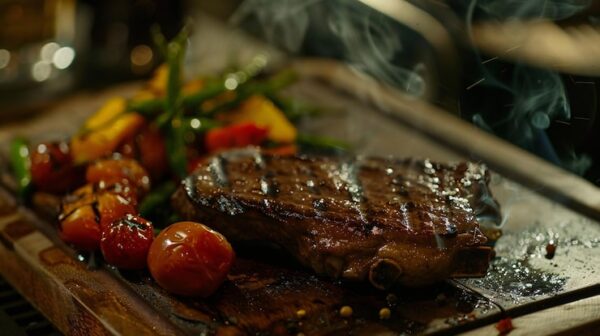
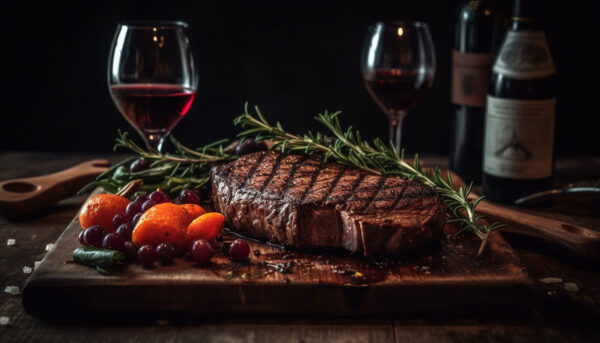
Tartan’s signature doesn’t care about the commute. The marbling carries enough internal fat to retain heat and moisture far longer than leaner cuts. Ask for it two degrees under your usual — it’ll cook slightly in the container and arrive exactly where you want it. This is the dish that makes you forget you’re eating off a coffee table.
2. Short Rib Pot Pie — Excellent Traveler (Travel Score: 88%)
A revelation in a box. The braised short rib filling actually deepens in flavor during transit as the juices redistribute and settle into the sauce. The flaky crust softens slightly — a trade some might prefer to the original crunch. Either way, it lands beautifully and requires absolutely nothing from you except a fork and an honest appetite.
3. Truffle Mac & Cheese — Great Traveler (Travel Score: 80%)
The richest side on the menu is also the most forgiving. The béchamel base holds its emulsification under stress in ways that thinner sauces simply cannot. The truffle aroma fades maybe 20% during transit, but the gruyère pull is still a full-on moment when you open the container. Order the large format — it reheats more evenly and cools slower.
4. Bone Marrow Toast — Decent Traveler (Travel Score: 55%)
The marrow itself is fine. The sourdough toast, however, begins its sad surrender to steam the moment the lid closes. Request the bread on the side, untoasted, and finish it in your own oven at 400°F for four minutes. That one small ask transforms this from a soggy disappointment into something nearly tableside-worthy.
5. Wedge Salad — Fair Traveler (Travel Score: 50%)
Order it undressed — a crucial instruction. The kitchen will pack the blue cheese dressing and lardons separately without blinking. Self-dressed at home, it’s nearly tableside quality. Pre-dressed? You have a limp iceberg tragedy on your hands that no amount of optimism will fix. The distinction between these two outcomes is one sentence spoken at the time of ordering.
6. Béarnaise Filet — Poor Traveler (Travel Score: 18%)
The filet itself is forgivable on a good day. The béarnaise is not — it breaks within minutes into a greasy, separated pool that coats everything it touches. This is a restaurant-only dish, full stop. Save the filet order for when you’re actually sitting in the room. No packaging innovation, no reheating trick, and no amount of wishful thinking will resurrect a broken béarnaise after a car ride.
“The ribeye doesn’t need the restaurant. The béarnaise absolutely does. Know the difference and your takeout game changes permanently.”
The Science of the Steakhouse Commute
Why do some steakhouse dishes travel beautifully while others fall apart before the car clears the parking lot? It comes down to the physics of carryover cooking, moisture management, and emulsion stability — three forces at war inside every takeout container.
Heavily marbled cuts like ribeye and short rib carry a natural insulation advantage. The intramuscular fat acts as a heat reservoir, slowing the rate at which the internal temperature drops. A medium-rare ribeye pulled from the grill at 130°F might still sit at 118°F twenty-five minutes later — still glorious. A lean filet, by contrast, drops below the pleasure threshold far more quickly, leaving you with something texturally closer to shoe leather than supple beef.
Emulsified sauces — hollandaise, béarnaise, any butter-based affair — are a different kind of fragile. They require constant temperature equilibrium to stay stable. The container’s trapped steam creates a humid microclimate that destabilizes the emulsion from the outside in. No styrofoam lid will save them. Order your sauces on the side if Tartan will accommodate it, and gently rewarm them in a double boiler at home. It takes five minutes and the results are dramatically better.
6 Insider Tips for Ordering Right
1. Order your steak rarer than you think. Carryover heat inside sealed containers raises the internal temperature by 5 to 8 degrees Fahrenheit. A medium-rare order might arrive medium. Adjust down one level when you place the order and trust the math.
2. Ask for sauces on the side — always. Tartan’s kitchen accommodates this without fuss. Pick up the hollandaise, the béarnaise, and even the compound butters separately. Keep them in their ramekins until you’re at the table and ready to eat.
3. Crack the container lid en route. A slightly vented lid prevents excess steam buildup, which is the silent killer of crispy surfaces and structural integrity on bread-forward dishes. A half-inch gap does the job without letting heat escape too aggressively.
4. Use a cast iron for reheating. Two minutes in a screaming-hot dry cast iron pan will restore the Maillard crust on any steak better than any microwave or oven approach. It sounds like more effort than it is, and the difference is not subtle.
5. Sides travel better in bigger portions. The truffle mac in the large format cools slower and reheats more evenly. The heat-to-surface-area ratio is your friend on pasta-forward sides. This is not an excuse to overorder — it is a genuinely practical tip, though the two outcomes are not mutually exclusive.
6. Rest before you plate. Even in a container, your steak benefits from resting. Open the lid at home, let it breathe for three minutes before transferring it to a warm plate. The juices redistribute. The experience improves. It costs you nothing.
What Tartan Gets Right About the Takeout Experience
The unglamorous truth about most steakhouse takeout is that it’s an afterthought — the restaurant equivalent of a vending machine installed because the landlord required one. Tartan is different, and it shows in the packaging decisions alone.
Their containers are insulated, not just cardboard. The sauces arrive in sealed ramekins, not flimsy plastic cups that leak into everything. The steaks are wrapped in foil within the container to prevent moisture accumulation on the crust. These are not accidents. Someone at Tartan thought seriously about what happens to their food after it leaves the pass, and it shows in every detail.
The dessert situation is worth a standalone mention. Their butterscotch pudding — dense, lacquered, arriving in a little glass jar they apparently have no qualms about sending into the wild — is not only the best takeout dessert on the menu but possibly the best takeout dessert this reviewer has encountered from any steakhouse anywhere. It does not require the restaurant. It barely requires a spoon. Order it every single time.
The Bottom Line
Tartan’s takeout menu isn’t a compromise — it’s a curated list hiding inside a larger one. Lead with the ribeye or the short rib pot pie. Build your sides around the truffle mac and the roasted bone-in broccolini. Order the butterscotch pudding unconditionally and without apology. Skip the béarnaise filet and any preparation that depends on a delicate emulsified sauce for its identity.
Follow these rules and your living room becomes, for one evening, something close to a very good steakhouse — minus the parking, the dress code, and the 45-minute wait for a table on a Friday night.
About Tartan of Redlands
Some restaurants open. Others take root. Tartan of Redlands, which first opened its doors on April 15, 1964, belongs firmly in the second category — a neighborhood institution that has quietly outlasted trends, ownership changes, and six decades of shifting dining culture without ever losing sight of what it set out to be.
The story begins with three brothers. Velmer, Al, and Art Ctoteau launched Tartan with a philosophy that was almost stubbornly simple: cook honest food, treat people well, and let the rest take care of itself. No gimmicks. No reinvention. Just a steakhouse that meant it. That founding conviction turned out to be remarkably durable.
Over the decades, the restaurant welcomed new hands without surrendering its soul. Larry Westin became a central figure in Tartan’s story, partnering with the Ctoteau family and helping to carry the restaurant forward through years that tested many other establishments in the region. When Westin passed away in 2003, his son Larry Westin Jr. stepped into the role with the same sense of responsibility, stewarding the restaurant for more than a decade before passing the torch in 2015.
Today, Jeff and Lisa Salamon own and operate Tartan, and the transition feels less like a change of hands than a passing of a flame. Jeff, a Marine Corps veteran who came to Redlands by way of Boston, brings to the dining room the same values he carried through his military service — loyalty, accountability, and a deep investment in the people around him. Those values are not abstract at Tartan. They show up in the way regulars are greeted, in the consistency of the kitchen, and in the kind of unhurried hospitality that can’t be manufactured or franchised.
The menu anchors itself in the classics that have kept locals coming back for generations. Saturday prime rib remains a near-sacred weekly tradition for a faithful crowd. The steaks are what a steakhouse steak should be — straightforward, well-sourced, and cooked with care. And the Redlands Tartan Burger has earned its own quiet mythology among regulars who know exactly what they’re getting and wouldn’t want it any other way. A full bar rounds out the experience, giving the space the kind of easy conviviality that makes a 7 o’clock dinner stretch comfortably past nine.
People have taken to calling Tartan the “Cheers of Redlands,” and the comparison holds more truth than nostalgia. This is a room where the bartender knows your order, where the same booths host anniversaries and post-game dinners and first dates with equal ease, and where newcomers are made to feel like regulars somewhere around the time the bread basket arrives. Indoor and outdoor seating means the restaurant adapts to the season rather than asking its guests to. That flexibility is a small thing that adds up to something larger over time.
Sixty years is a long time for anything to survive. For a neighborhood steakhouse to not just survive but to genuinely matter to its community after six decades — that takes something beyond good cooking. It takes the kind of institutional character that Tartan has been quietly building since 1964, one meal at a time.